
- Home
- Hokkaido, Japan
- Investing in Japan Real Estate: A Foreign Investor’s Complete Guide (2025)
Review of Investing in Japan Real Estate: A Foreign Investor’s Complete Guide (2025)
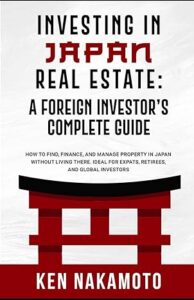 As part of our collection of reviews of Japanese real estate books, we present this review of the book Investing in Japan Real Estate: A Foreign Investor’s Complete Guide, by Ken Nakamoto.
We wrote this review to give the the reader a better idea of what this “book” is, and what it is not. To say it quickly; this is a very low quality book. Compared to almost every other book in the category, this effort feels at least incomplete, if not insincere.
Investing in Japan Real Estate Book by Ken Nakamoto
— Overview of Nakamoto’s Book for Foreigners Investing in Japanese Real Estate
— Who is Ken Nakamoto?
— A Pamphlet Pretending to Be a Book
— A Poor Guide, Woefully Incomplete
— Are There Better Books on Investing in Japanese Real Estate?
— Working with Local Real Estate Agents in Japan

Overview of Nakamoto’s Investing in Japan Real Estate: A Foreign Investor’s Complete Guide
The full title of this product is Investing in Japan Real Estate: A Foreign Investor’s Complete Guide – How to Find, Finance, and Manage Property in Japan Without Living There – Ideal for Expats, Retirees, and Global Investors.
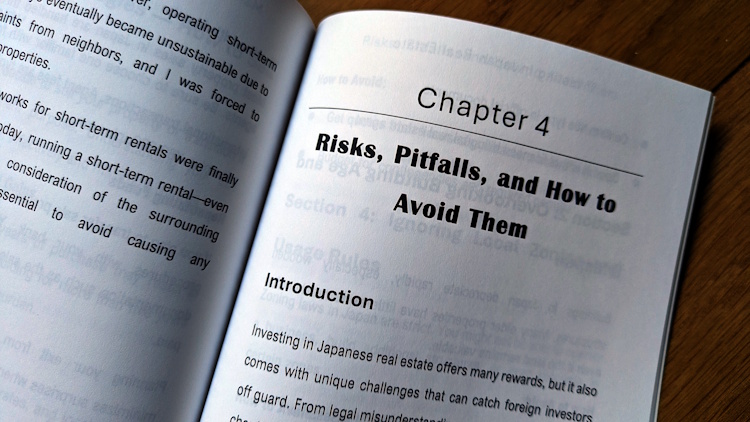
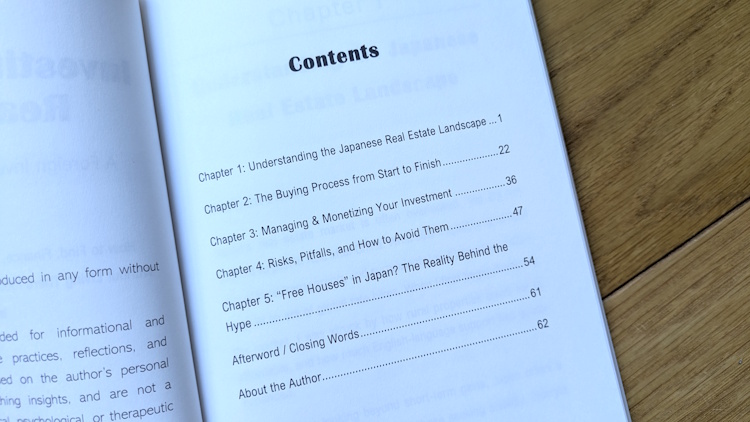
We purchased the book, and paid the full retail price of ¥3,637, and received a physical copy that is now in our library. The version of the book we purchased has seven chapters. If you exclude his Afterword and his About the Author chapters, (less than one page each), you’re left with five chapters of content, approximately 60 pages. While the book is small (14 x 23 cm), and very thin (approximately 5mm?), inside the product displays the content in a very large type face, with the lines of type “double spaced.”
The book appears to be something like “self published.” The overall quality of the production has many of the formatting errors common in self-published work. If the quality of the information is good, formatting should be a secondary concern. In this instance, it is our humble opinion that the author has tried to take a very limited quantity of completely generic information, and then “stretch it out” to fulfill some claim of being a “book,” and a “complete” guide.
A reasonable person, with even a basic knowledge of real estate in Japan, may find the claim of being a “complete guide” to an almost hysterical overstatement.
Who is Ken Nakamoto?
To provide value to others in a domain like real estate, it helps if you have some actual authority on the topic. Here is how the entity listed as author Ken Nakamoto describes himself:
With over 15 years of hands-on experience in Japanese real estate, global trade, cross-border business, he wrote this guide to share practical insights that may help other international readers navigate the Japanese property market with greater clarity and confidence.
— From the text of Investing in Japan Real Estate
If Nakamoto is an author, it is not easy to find anything else published under the name Ken Nakamoto. If whomever wrote this book has “over 15 years of real estate experience,” they do not list any affiliations or qualification in the product, no work history, no external credibility at all. There are some references in the inside cover to “coaching” and an odd disclaimer about “personal development and wellness.”
Always consult a qualified health and mental health professional before beginning any new personal development or wellness practice.
Why would a line like that be included in a “complete guide” to foreigners investing in Japanese real estate? I have no idea. It is possible it was cut and pasted from some other persons book?
There is a trend in modern information marketing where various entities in the category of “copywriters” do basic research, create thin, information products, and market them to the public for profit. Often, these products are written by copywriters that are not experts at all. In recent years, it is not ridiculous to assume some of these products are AI creations.
As we have personally read and reviewed several books about real estate in Japan, this book is literally the weakest example in the category. We do not know if whoever published this book does not possess much of value to say about the topic, or just didn’t put in enough effort. It would be a reasonable assessment to say the book is perhaps guilty of both.
A Pamphlet Pretending to Be a Book
We are passionate students of real estate. We love the category, and study regularly. When we saw there was a new title, we were somewhat cautious, but – at the same time – excited to see what Nakamoto had created. In retrospect, if I had noticed it was “68 pages” (as the online listing states), I might have been more measured in my anticipation. As it arrived, just flipping through it, I was immediately disappointed.
We are not certain if there is an agreed upon standard of what qualifies as “a book.” If there was a minimum standard, it would be hard to imagine how Nakamoto’s Investing in Japan Real Estate book would qualify. This book reads like a poorly researched internet article, or a bad ebook, awkwardly repurposed as a commercial book. If an undisciplined high school kid were assigned Japanese real estate investment as a topic, and waited until the night before to write the paper, poaching 100% of the content from a light read of other peoples’ bad articles or ebooks, the output might actually be better than this particular book.
This “book” is smaller, and lighter, than almost any magazine. Nakamura’s effort is essentially a “pamphlet.”
As a total guess (no calculations were made in this estimate), we might assume this “book” is less than 5,000 words. It is possible to provide real insight in a brief effort, but compared to any other book in the category, this product uses the most obvious sources, and provides the lightest, most superficial coverage of the topic we have ever seen.
A Poor Guide, Woefully Incomplete
As for the claims inherent in the title – such that the book is “a foreign investor’s complete guide,” or that this product might be “ideal for expats, retirees, and global investors” – those claims are so ridiculous that a reasonable person might assume the author was trying to misrepresent the value in the book. Does the author genuinely believe the “book” to be a complete guide? Does he actually think this resource is “ideal” for anyone?
We would normally fill a review like this with the most interesting notes from our reading or the best of the helpful information provided. In this case, it is very hard to find anything of value in Nakamoto’s book at all. We will provide some very brief examples:
In his description of the potential of real estate in Japan, Nakamoto says:
What sets it apart is its unique mix of legal transparency and surprisingly low borrowing costs – even in an era of global rate hikes.
His reference to “surprisingly low borrowing costs” may be correct, but low costs for “whom?” Is this book designed for “expats” and “global investors?” If so, loans are almost impossible for non-residents. So the “low borrowing costs” are mostly applicable to native Japanese buying personal residences. What is his point in suggesting Japan offers financing to foreign investors at all?
Later in the book, he makes that same point himself.
Japanese banks rarely provide mortgages to non-residents. Most non-resident buyers purchase properties with full cash payments.
That is correct. It’s a very basic point, but at least it is not misleading. He adds, “Some exceptions may apply via foreign Banks or offshore branches,” with no examples of any banks at all, or any of the circumstances that might make a loan possible.
The author gives a similarly weak assessment of the akiya phenomenon – and of course he does; his low quality insights on akiya could have been formed by simply paraphrasing the most obvious headlines from Japanese real estate articles.
These vacant homes are often incredibly cheap or even free, especially in depopulated towns.
He makes an equally vapid admission that these homes are “rarely free in practice,” demonstrating, again, that nothing of interest is to be found in his product. He does at one point refer to the potential to “renovate an akiya into a stylish guesthouse.” Does Nakamoto have any personal experience at all with akiya? Do we believe he has any expertise on style or guesthouses? If he does, it is not at all obvious.
At the end of each “chapter,” Nakamoto provides an “Author’s Tip.” As an example of the quality of his “tips,” we offer this reference:
If you have sufficient investment capital, investing in central Tokyo is highly recommended.
Wow. To demonstrate his rare understanding of the market, Nakamoto wants the reader to see he has discovered that Tokyo has nice real estate. Compared to what? Compared to nothing. The author offers no other examples at all. This is like writing a “guide” to “Real Estate Investment in the United States” and offering the “tip” that New York City is “recommended.” Just… embarrassing.
Ideal for expats, retirees, and global investors.
He uses the word “investor” more than a few times in the text, but somehow manages to not even mention any criteria investors use to evaluate rental properties (in Japan, or anywhere else). If he mentioned the words “expat” or “retiree” at all in the book, I didn’t recall seeing either term. His reference to these terms seems entirely to present usefulness and relevance he has not earned.
For another example; He uses (and abuses) the term “tax agent” again and again. He says you “need to appoint a tax agent.” Is that so? Elsewhere he talks about the need for a Japanese “tax administrator,” without clarifying if that is the same, or a different professional than the aforementioned tax agent. He also says you’ll need a “legal representative,” with no context there either. Are those three different professionals? Are they all “required?” The truth is they could all be the same individual, and none are required by law. Japan real estate law does stipulate that a “domestic contact” for real estate in Japan is required (but, according to judicial scriveners we know, rarely used in practice). As a reader, I had no confidence he really understood any of those ideas at all.
The book is in no way complete. And while claiming to be a “guide” doesn’t necessitate that one is a competent guide in any way, Nakamoto is a clearly woefully disappointing guide. It’s not obvious this book is a sincere effort to provide any value at all.
While Nakamoto makes some shallow references to some personal real estate transactions of his own, the only specifics he supplies is in his very anemic treatment of minpaku and short-term rentals in Japan. He mentions “operating short-term rentals in central Tokyo” and says that he “was forced to withdraw from all properties.” That’s his expertise? All the properties? He couldn’t make anything he’d established work? But now, he is writing a guide for other investors?
There may be nothing criminal in publishing a book this bad, but it is shameful to present itself as any source of expertise.
Are There Better Books on Investing in Japanese Real Estate?
It is our opinion that just about every book ever published on the topic of investing in property in Japan is better than this one.
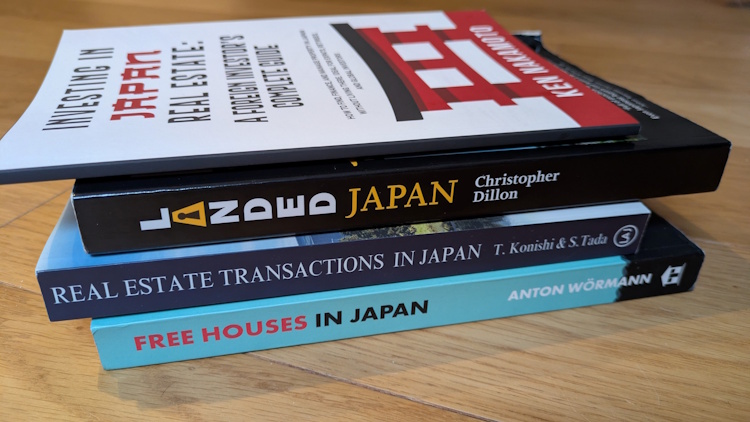
While we cannot know the true motivations of the “author” presented as Ken Nakamoto, it is our opinion (only) that we do not believe this was a sincere attempt at all. But if it was an earnest effort, it seems like it aimed to co-exist along side much better books, such as Landed Japan, by Christopher Dillion. Landed Japan is written by an author of real authority, and is in every way a more genuine, substantial effort than Nakamoto’s fluff piece. While it is over 10 years old, it provides a much more complete look at the topic.
For a more recent example, in 2023 Konishi and Tada released Real Estate Transactions in Japan; an incredibly thorough and credible book, providing details of real estate transaction in Japan from multiple perspectives. The authors are real estate lawyers in Japan, and bring expert perspective and specificity that Nakamoto’s work of “copywriter slop” does not.
If the topic of akiya interests you, Free Houses in Japan by Anton Wormann is a refreshingly sincere, high-quality book. The author Wormann shares very specific detail on his own experiences and at least one detailed case study. Wormann’s book was a joy to read, and he has gone on to establish himself as an extremely knowledgeable and entertaining expert in the space.
For a specific physical comparison, we took a picture of the three other books mentioned above, with Investing in Japan Real Estate resting on top of the pile.
As we have personally read all of these titles (and more), of course we were disappointed that anyone would release such an inferior addition to the category. The content is so amateur, it seems like it could only be a shameless attempt at a cash-grab, as it would otherwise be incredibly naive to bother to publish it at all.
Can we find anything at all positive to say about this book? Not really. Any reader that bothers to read it, would have been better served by reading Wikipedia articles. Any consumer that paid for it, would have most certainly made better use of the money anywhere else (certainly by buying any other book than this one).
Working with Local Real Estate Agents in Japan
The only place Nakamoto comes close to providing anything like “good guidance” is where he suggests working with local real estate agents.
Look for agents who specialize in working with foreign clients. Many can assist with everything from financing and tax representation to visa related matters.
It is a good idea to work with a local buyer’s agent. It is not, however, realistic to think agents will help with financing (particularly if you’re a non-resident) or with visa matters (an absurd suggestion, the last thing an agent wants is to burn time on a foreigner’s visa concerns).
Later in the book, when talking about setting up utilities, the author claims “[m]ost foreign buyers ask their agent… to arrange these services.” While it is possible an agent also operates a separate, fee-based property management business, no; agents do not handle setting up utilities for their real estate clients. Even suggesting so would be a red-flag to an agent. No credible expert in Japanese real estate would suggest you ask your agent for that kind of help.
Not Recommended – Study Almost Anything Else
There is a part of me that can imagine a very old person producing a book like this; someone that does in fact have some limited experience, even if their ideas were not at all insightful. Imagine a well-intentioned, but useless vanity project – “I just wanted to share some of what I learned” kind of thing. I could forgive an author for writing something like that.
If that were the case, you would never claim to be “a complete guide.” That is marketing-speak, and given the quality of this product, the combination of over-promising and under-delivering deserves contempt.
Your feedback not only helps other international readers discover the book- it also encourages me to continue creating useful, practical resources for foreign investors in Japan.
This review has more original thinking, and is a more sincere effort to produce something useful, than Nakamoto’s Japanese real estate book.
Our intention in writing a review of Investing in Japan Real Estate: A Foreign Investor’s Complete Guide is simply to provide a warning about the (lack of) quality in the book; I paid for a copy, I read it (in about 30 minutes), you don’t have to. For better, more worthy books on the very interesting topic of investing in real estate in Japan, see our list of Japanese real estate books for better alternatives.
For in-person help with investment property in Hokkaido, if you’d like help finding a real estate broker to find investment property in Sapporo, please contact us. We’re happy to help.

We work for you, not the real estate companies.
We provide person-to-person introductions to prescreened agents that help you sell, buy, lease, or rent property in Hokkaido. We search our custom database to connect you to real estate professionals that speak your language, address your needs and are available now to help you find what you want.
Local. Trusted. 100% free to you.
To Get Started
For More Information:
— Different Real Estate Investment Opportunities in Sapporo
— See our piece about various Taxes in Japan
— Our detailed Guide to Paying Property Taxes in Japan
— We provide a list of Sapporo Tax Offices
— In Hokkaido, there are areas with special rates for property taxes
— Our review of the role of Property Management Companies in Sapporo
— Buying Property in Hokkaido as a Foreigner
— Our list of Tax Accountants for Expats Living in Japan
— Our complete guide for Buying a House in Sapporo
— Our report on How to Rent an Apartment in Sapporo and Move-In Costs for Sapporo Apartments
— Find Lawyers in Hokkaido
— Tax representatives in Japan
— Services that Help Foreigners Buy International Real Estate
See also:
— Examples of rental properties in Osaka City, Japan
— Guide to buying real estate for investment in Osaka
— Types of investment property in Osaka, Japan
— Off-market Properties in Osaka
— Examples of investment property for sale in Kobe, Japan
— A guide to the concept of Domestic Contacts in Japanese Real Estate